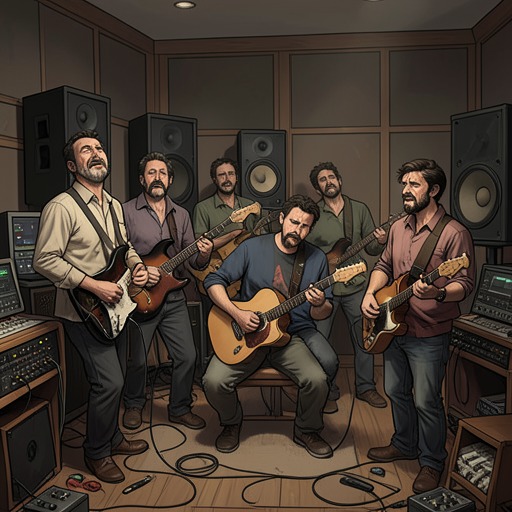
The Six moves to Los Angeles
Daisy Jones & the SixThe Six’s move to Los Angeles begins as a practical wager on where a band might find its future, but it quickly becomes a personal rupture as well. Rod Reyes has contacts out west and urges the group to go; Billy Dunne feels compelled to pursue music, and the others are ready to leave. They pack into a van, say goodbye to home, and travel from Pennsylvania to California, playing along the way. By the time they reach Los Angeles, the band has exchanged familiar surroundings for a city of gigs, music, and possibility—and Billy has left Camila Dunne behind.
The decision to go west
Rod Reyes recalls that his contacts were already in Los Angeles and that, around 1972, he proposed the move to the band. Eddie Loving’s view was broader: California was where exciting things were happening. Billy describes an inward need to pursue music, while Warren Rhodes is ready to get into the van. The accounts give the decision several motives at once: access to contacts, the pull of a music scene, and the conviction that the band could not reach its ambitions by staying where it was.
For Billy, that decision also meant asking Camila to choose whether to join him. He went to her parents’ house and invited her to come west with the band; she asked what she would do there. Camila’s refusal and Billy’s inability to stay turn the move into a separation, not simply a change of address. Billy understands that she has chosen not to come, while Camila later remembers feeling ill without him, waking in tears, and regretting the decision day after day. Her mother urged her to find him and take it back, but Camila believed Billy had already gone on to pursue his dream. The move therefore starts with two incompatible necessities: Billy’s determination to leave and Camila’s sense that she cannot follow.
The journey and arrival
The band’s departure also closes one chapter of family life. Graham Dunne recalls that the group said goodbye to their mother, who had married the mailman, and then got into the van. His continued use of that nickname, even though he knew the man’s name, gives the farewell a plain, unceremonious quality. The band did not travel straight to a settled career: they played gigs along the way from Pennsylvania to California, making the westward journey itself part of their working life.
Once they reached Los Angeles, Rod Reyes used his favors to arrange a few rooms at the Continental Hyatt House. The band soon began playing bigger gigs. A former concierge could not recall the group’s arrival amid the many bands passing through, a small indication of how crowded the local scene was; he remembered meeting Billy Dunne and Warren Rhodes later. For the band, however, the city’s scale and activity were part of its appeal. Eddie Loving remembers being surrounded by people who loved music and liked to party, with attractive women and inexpensive drugs everywhere. His account presents opportunity and temptation side by side, without suggesting that the move immediately solved the band’s problems.
A new stage, and what remained behind
In Los Angeles, The Six played around Hollywood, including the Whisky a Go Go, the Roxy, and P.J.’s. Billy had written “Farther from You,” a song about missing Camila and feeling distant from her. Its subject makes the separation audible: the band’s arrival opens professional doors, while Billy’s new work registers the person who is no longer beside him. The move thus produces both forward momentum and an enduring reminder of what that momentum cost.
The Whisky a Go Go later becomes a place where the band’s changing lineup and sound are visible in performance. When Daisy Jones appears while The Six is playing there, Billy invites her to sing “Honeycomb.” Karen Karen recalls Daisy and Billy standing at the same microphone, watching one another as they sang; they harmonize at the end, although that ending was not on the record, and the audience responds with loud cheers. The scene does not erase the circumstances of the original move, but it shows the Los Angeles stage becoming a setting for a new creative partnership.
Later reach and significance
The group’s later television appearances mark how far its public reach extends beyond the first rooms arranged on arrival. On Saturday Night Live, Lisa Crowne introduces Daisy Jones & The Six to an ecstatic audience. The band performs “Turn It Off,” by then a widely known, award-winning song, with a crispness that remains vivid despite repeated performances. Billy and Daisy move to the same microphone and face one another as the song’s lyrics become more pointed. Their performance is both a polished broadcast and a moment that seems intensely personal to the people watching it.
That later success should not reduce the move to a simple origin story in which leaving home guarantees achievement. The evidence instead places ambition beside divided loyalties: Rod’s contacts and the larger gigs make the westward choice consequential, while Camila’s absence and Billy’s song keep its intimate cost in view. Los Angeles gives The Six new rooms, stages, and opportunities; it does not make the separation that brought them there disappear.